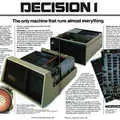
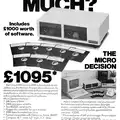
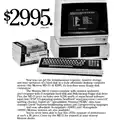
Morrow Designs Advert - February 1983
From Practical Computing
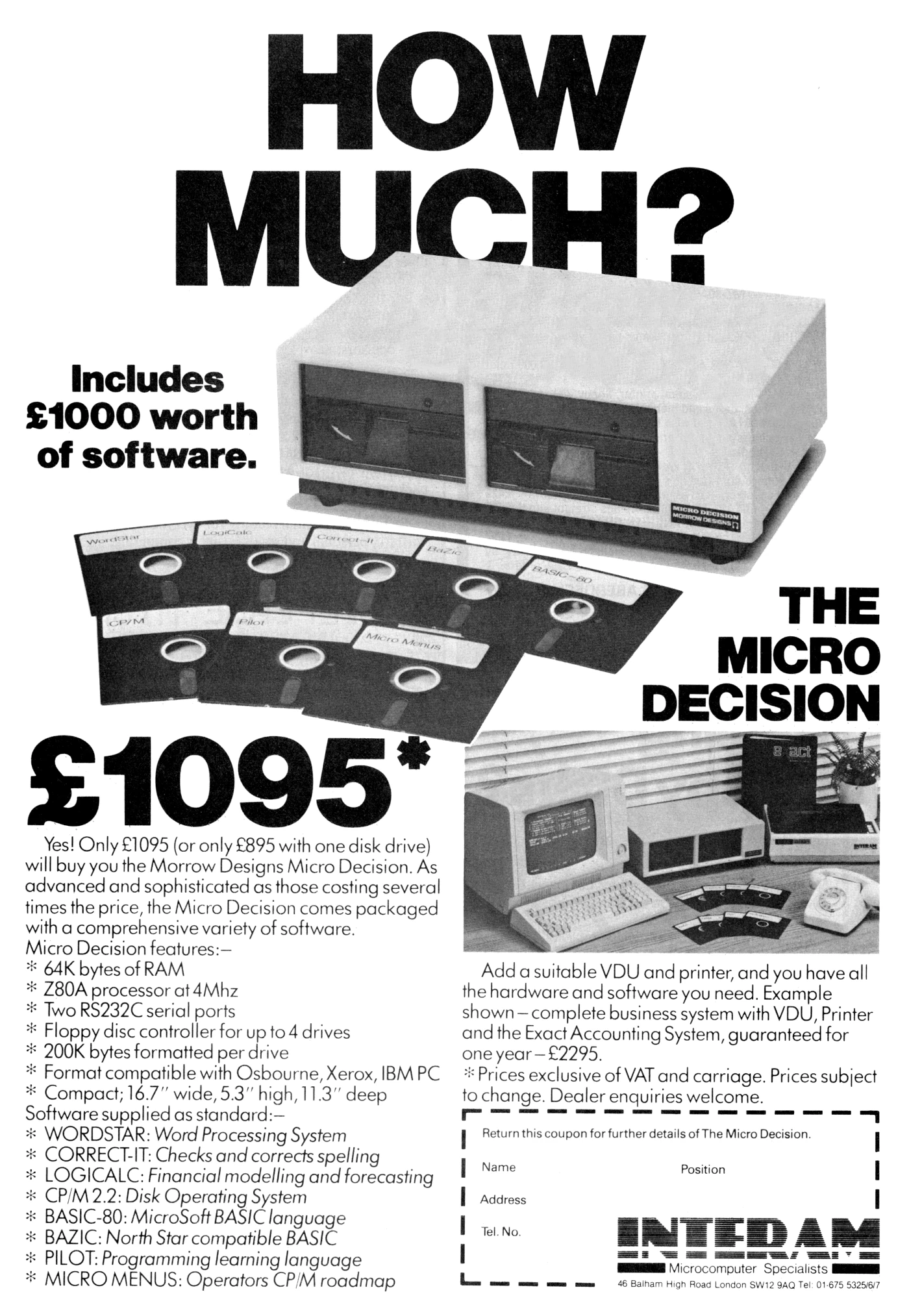
How much? The Micro Decision for £1,095
George Morrow had started making products for microcomputers in 1976, having joined the influential Homebrew Computer Club which had formed in the wake of the launch of the Altair 8800 at the very beginning of 1975.
Morrow's early products included add-ons for both the Altair and the IMSAI 8080 - effectively a clone of the Altair - as well as a successful 4K memory module, which he sold to Bill Godbout, another famous name from the early homebrew scene.
Morrow's company went through several names including Thinker Toys, until legal action from CBS sub-division Tinker Toys caused a change of name to Morrow Designs.
One of its first products was the Equinox 100, a machine sold through Parasitic Engineering, however it failed to sell that well as it was based on Intel's 8080 processor at a time when Zilog's Z80 was becoming far more popular for small business micros.
The company went on to launch the Decision 1 micro in 1981, before releasing the Micro Decision series in 1982.
On the face of it it was just another Z80 micro, although it was pitched as a particularly-affordable machine[1], with its fanless single-board design and lack of keyboard and video interface contributing to its budget price.
Although for Morrow it was a departure from the company's earlier machines as it didn't use the S-100 bus, it wasn't otherwise particular ground-breaking, and was even said by the magazine Microsystems to have been a "marketing-driven, not a technology-driven machine"
And if you believe that micro companies were paying the full retail price for the software that they bundled, then the company was actually paying the purchaser thanks to the claimed £1,000 worth of software included with the machine, which only cost £895 plus VAT - or about £4,700 in 2026 - for the single-drive version.
However, that was just for the computer itself - it also required a terminal of some sort in order to do anything useful, and shipped in the US with the option of a Lear-Siegler ADM-20, which plugged into one of the two available RS232C ports - the other port was configured primarily for use with a printer[2].
Morrow Designs even released a hard-disk interface for the MD which was said to make it the cheapest hard-disk CP/M machine available anywhere[3].
Bill Machrone, writing in February 1983's Microsystems, also said of it that:
"The Morrow Micro Decision is a good little computer. The amount of machine and software you get for the price is simply stunning. Until now, the only machine to offer so much for so little was the Osborne 1, a system not without some idiosyncrasies of its own. Okay, I would have liked a little more horsepower in the I/O department, and I could always make a case for more disk storage. But this is an entry-level package, and it's unlike any other entry-level package offered to date[4]".
The Micro Decision's reseller in the UK - Interam - was also offering a bundle including a dumb terminal, which provided the necessary screen and a keyboard, the micro itself, and an Interam-branded printer for £2,295, or about £12,000 now.
That's significantly cheaper than the equivalent IBM PC price, which including a printer would be somewhere north of £4,000, or £18,200 now, and that's not allowing for the seven additional software packages included with the Micro Decision.
These included WordStar, a simple spreadsheet called Logicalc, Microsoft's de-facto standard BASIC, the spell-checker Correct-It, a couple of utilities, and BaZic.
The latter was a version of the BASIC used on North Star's computers, and was a nod to George Morrow's former partnership with Bill Godbout, Chuck Grant, and Mark Greenberg, which had attempted to build a 16-bit system based on National Semiconductor's PACE CPU.
Differences of opinion led to Grant and Greenberg leaving to form North Star Computers, which produced a range of microcomputers popular enough to become a mini-standard in their own right, with compatibility cropping up on machines as diverse as Hotel Microsystems' Minstrel and Comart's Communicator.
The bundling of software had become almost a necessity since Osborne had released the Osborne 1, which came with a large amount of bundled software that - like Morrow's advert here - was claimed to be worth about as much as the machine it shipped with.
Morrow, who was famous as a source of quotes about the industry, said of Adam Osborne, the founder of the eponymous micro company, that:
"Adam Osborne was initially successful not because he introduced portability, but because he provided utility through bundled software. To be successful, a product must satisfy a need in the market by providing utility where there was none before."
Although Morrow was clearly less than impressed with the commercial practices of software companies, saying:
"The only industrial costs software companies have is the printing of serial numbers. What drives the prices so high is thievery[5]."
Morrow's final product was the lunch-box-shaped Pivot Portable, which it had also licenced to Zenith Data Systems.
Unfortunately, just as Morrow was going through some financial difficulties, it lost a huge potential contract with the US government to Zenith, which beat it with Zenith's version of the Pivot.
Morrow Designs went bankrupt shortly afterwards.
Date created: 12 July 2026
Last updated: 15 July 2026
Hint: use left and right cursor keys to navigate between adverts.
Sources
Text and otherwise-uncredited photos © nosher.net 2026. Dollar/GBP conversions, where used, assume $1.50 to £1. "Now" prices are calculated dynamically using average RPI per year.